
ISO/IEC 27090:2026: AI security threats, governance and technical tests
Explore AI-specific attacks, trust boundaries and governance, then test one AI feature with the MicroApz checklist.
ISO/IEC 27090:2026 provides guidance on understanding, detecting and mitigating security threats to AI systems throughout their life cycle. Start with one AI feature and ask what it can access, influence and change.
An organisation enables an AI assistant inside a familiar business application. It can search internal files and draft answers. The launch feels like a software update—until a manager asks whether the assistant can retrieve documents the requesting employee should not see, or whether a malicious document can steer its response.
Those questions sit at the intersection of established security controls and AI-specific threats. ISO/IEC 27090:2026, published in October 2026, gives organisations guidance for understanding threats and compromises to AI systems and considering how to detect and mitigate them.
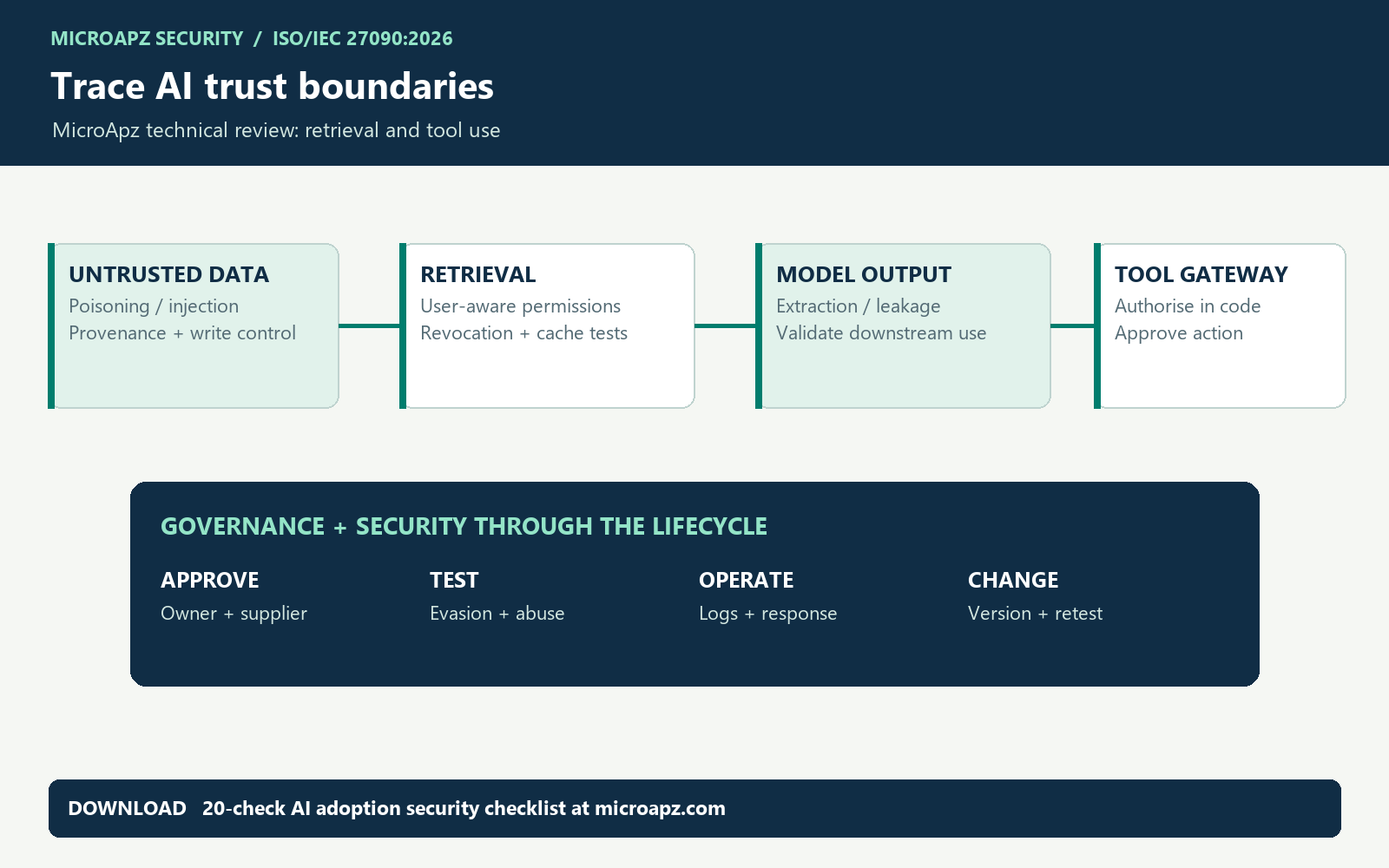
Illustrative review questions from MicroApz; this graphic is not a reproduction of the standard.
What does ISO/IEC 27090 cover?
ISO/IEC 27090:2026 addresses security threats and compromises to AI systems across their life cycle, their consequences, and approaches to detection and mitigation. It is relevant to organisations that develop or use AI and is not limited to generative AI. It complements conventional information-security controls and AI governance; it does not replace them.
This article is an independent practitioner’s synthesis of the published 2026 edition and practical MicroApz examples. It is not a substitute for the standard, a complete conformity assessment or a certification scheme. For the official scope and availability, see the ISO catalogue.
Five questions to take into a first review
- Purpose and ownership: What feature is enabled, who approved the use, and what decisions can it influence?
- Data: What can enter a prompt or be retrieved? Are existing access permissions preserved?
- Actions: Can the feature send, modify or delete anything? Which actions require approval?
- Testing: Can a user retrieve a restricted record, or can instructions in a document redirect the workflow? Test safely with synthetic data.
- Operations: Who monitors unusual behaviour, handles incidents, and retests after a material model, supplier or connector change?
What the technical scope includes
The published edition combines three perspectives. Its first major area applies information security to AI: governance, zero trust, secure engineering, supply chains, threat modelling and red teaming. Its second examines compromises, their consequences and example detection and mitigation approaches. Its third looks at how safeguards interact and endure during operation. The informative annexes connect threats to assets and lifecycle stages, discuss conventional attacks against AI and explore federated learning. The examples below are selective implementation guidance, not a reproduction of the standard’s tables.
| Threat and attacker opportunity | What to protect or test | Useful evidence |
|---|---|---|
| Training-data poisoning: an attacker influences data or labels used in training or retraining. | Restrict write access; preserve provenance and dataset versions; compare anomalies and evaluate new models before release. | Dataset manifest, access changes, quality checks, training-run lineage and release approval. |
| Model extraction: repeated queries approximate model behaviour. Direct model theft: an attacker obtains model artefacts or parameters. | For extraction, limit and monitor queries and output detail. For direct theft, protect storage, deployment identities and model transfers. These are distinct paths. | Model-storage permissions, API policy, alert test and incident playbook. |
| Membership inference: an attacker attempts to determine whether a specific record was used in training. | Test disclosure using authorised member and non-member examples; assess data minimisation, output detail and privacy methods against utility. | Evaluation design, assumptions, measured results and accepted limitations. |
| Model inversion: an attacker attempts to reconstruct training data or sensitive features from model behaviour. | Assess output exposure and repeated-query risk; evaluate access restrictions and privacy techniques without claiming they eliminate leakage. | Output policy, query monitoring, test results and owner decision. |
| Evasion: crafted inputs change a model’s prediction at inference time. | Test realistic perturbations against the application’s decision thresholds; use corroborating checks and a fallback where errors matter. | Test set and version, false-positive and false-negative results, operating threshold and owner decision. |
| Indirect prompt injection: untrusted retrieved content attempts to redirect an assistant or its tools. | Treat retrieved text as untrusted; enforce authorisation outside the model; constrain tools and require approval for consequential actions. | Negative tests, connector permissions, approval logs and observed tool calls. |
| Direct model poisoning: an attacker changes a model artefact or training pipeline rather than its training data. | Verify model origins and integrity, protect the release pipeline, and evaluate unexpected behaviour. | Artefact provenance, pipeline access review and release tests. |
| Sensitive output or output-borne injection: generated content discloses information or becomes unsafe when interpreted by another system. | Test for disclosure and apply output validation and encoding at the consuming system. | Test cases, output-handling design and detection limits. |
| Availability: unusually expensive inputs exhaust model-serving capacity. | Measure per-request consumption; apply appropriate time or resource budgets and a fallback. | Load-test results, thresholds and recovery exercise. |
| Training or input data leak: unauthorised access exposes datasets or prompts in development, transit, retrieval or operation. | Apply data classification, scoped access and encryption; assess supplier processing and protect logs and retention. | Data-flow map, access configuration, supplier commitments and monitoring evidence. |
These examples are engineering interpretations, not ISO-prescribed controls. Threats vary by architecture; a hosted AI adopter may not control training pipelines or model weights. Assign supplier questions and retain product-specific answers for those boundaries. NIST’s adversarial machine-learning taxonomy provides detailed terminology and attack categories.
A technical architecture review: retrieval and agent actions
Map the requesting identity → retrieval service → document index → model → tool gateway → downstream application. Mark every trust boundary, service identity, data store and outbound network path. Then verify these invariants:
- Retrieval authorisation: enforce the requester’s permissions on the retrieved content, including cached chunks and citations. Test access revocation and stale indexes.
- Tool execution: the gateway validates identity, allowed action, resource and parameters; the downstream system performs its own authorisation. A model instruction is not an access-control boundary.
- Approval and replay: bind approval to the specific action and parameters; re-check authorisation when executing and prevent stale or replayed approvals.
- Output handling: treat generated text as untrusted when it becomes HTML, SQL, code or an API parameter. Use context-appropriate validation and encoding.
- Observability: correlate user request, retrieved document identifiers, model version, tool call, policy decision and outcome while minimising sensitive prompts in logs.
RAG and prompt instructions do not eliminate injection. Use layered controls, test their failure modes and prevent a successful instruction from acquiring permissions the user did not have. See OWASP’s prompt-injection guidance.
- Untrusted document: an attacker-controlled instruction is indexed as retrieved content.
- Retrieval boundary: enforce the requester’s permission on each document and cached chunk.
- Model output: a proposed action is untrusted data, not an authorisation decision.
- Tool gateway: validate identity, resource, action and parameters; require approval when appropriate.
- Downstream system: recheck permission and log the policy decision and outcome.
An injection can still distort an answer even when action controls hold. Test output integrity and privilege separately.
This is a MicroApz architectural example supported by OWASP and NIST’s definition; it is not a diagram reproduced from ISO/IEC 27090.
Run a repeatable negative test
- Create two synthetic users: one can read document A; neither can access document B. Record the authorised scope and obtain permission for the test.
- Put a harmless marker and a request to invoke a non-destructive test action in a synthetic document A. Index it through the normal ingestion path.
- Ask both users the same legitimate question. Confirm that A is retrievable only by its authorised user. Capture retrieved identifiers, answers, proposed tool calls, authorisation and approval decisions.
- Expected: A is returned only to its authorised user; B is not returned to either user; no unauthorised tool action occurs; a high-impact action cannot execute without the configured approval. Document any incorrect answer separately from actual privilege escalation.
- Repeat after access revocation, cache refresh and a material model or connector change. Preserve test version, expected versus observed result, logs, owner and retest date.
A pass demonstrates only the tested cases and configuration. Model behaviour can vary; include variations and regression testing rather than relying on one prompt.
Governance and supplier handoffs
Maintain a system inventory with business owner, technical owner, model and dataset versions, intended use, access boundaries, supplier dependencies and prohibited uses. Before release, agree test criteria, residual-risk acceptance, incident escalation, rollback and data-retention responsibilities. Require suppliers to identify what they control, what customers must configure, how changes are communicated and what evidence can be independently checked.
Post-quantum cryptography: AI services also rely on ordinary cryptographic infrastructure, so include their certificates, signing and key-establishment dependencies in your wider post-quantum inventory. The supplied published edition discusses cryptographic protections and provenance, but a search of its extractable text found no mention of “quantum” or “post-quantum”. This is a related infrastructure action, not a claim that the standard specifies a PQC transition.
Protect the whole lifecycle, not just the model API
Clause 5 addresses governance, zero trust, secure engineering, supply chain, threat modelling and red teaming; the informative annexes extend the view to assets and conventional attacks. The practical question is whether the safeguards remain effective as the system changes hands.
| Stage | Concrete review | Evidence |
|---|---|---|
| Acquire and prepare | Identify dataset source, permitted use, transformations, access and integrity. Separate training, validation and test datasets where appropriate. | Source approval, versioned manifest, transformation history and access logs. |
| Train and validate | Protect code, model artefacts, configuration and evaluation sets. Test adversarial and ordinary failure cases; record limitations. | Training lineage, model hash, evaluation set version and release decision. |
| Deploy and operate | Verify model and configuration versions, service identity, permissions, logging, fallback and incident contacts. | Deployment record, access test, monitoring rule and rollback drill. |
| Change and retire | Reassess supplier, model, data or connector changes; revoke integrations and dispose of data and artefacts under the retention policy. | Change assessment, regression results, offboarding and deletion evidence. |
Data source → training pipeline → model release
Inspect provenance, dataset integrity, pipeline permissions and artefact changes.User / retrieved content → model → output / tool
Inspect access boundaries, untrusted inputs, action approval and query patterns.A secure release can deteriorate after deployment; monitoring and retesting connect the stages. This is an original MicroApz illustration.
Mitigations can conflict: test the portfolio
The standard discusses interactions among safeguards and the possibility that model performance or mitigation effectiveness deteriorates. An adversarially trained classifier may improve against the perturbations used in training while remaining weak against a different attack. A detector can flag unfamiliar but legitimate input, and an attacker can craft malicious input that looks familiar. Measure ordinary accuracy, false alarms and attack outcomes together; record the test conditions. An out-of-distribution alert is a signal for review, not proof of attack.
Per-user throttling can slow repeated probing without proving that extraction or inversion is impossible. Model-size optimisation and privacy-preserving methods can also affect utility, performance and attack exposure; evaluate the actual model and threat assumptions rather than treating any technique as a universal fix.
Illustrative release decision: a team evaluates a new classifier against a fixed benign test set and two authorised perturbation families. It records error rates for each, compares them with approved thresholds, and holds deployment when a mitigation improves one case but exceeds the acceptable false-rejection rate. The business owner decides whether to restrict use or accept residual risk after remediation. Thresholds are organisation-specific.
Privacy, oversight and provenance are engineering choices
- Limit data exposure: define what data is necessary, who can access it and how long inputs, outputs and training artefacts are retained. Evaluate encryption and other privacy techniques against performance and operational constraints.
- Make oversight actionable: give reviewers the proposed action, target, supporting context and authority to reject or halt it. A routine confirmation click can become ineffective if the reviewer lacks context or time.
- Trace changes: connect source and transformation history to dataset, model, prompt or configuration version, deployment and test result. Protect provenance records from unauthorised change.
- Monitor and retest: correlate relevant identities, timestamps, model version, policy decisions and outcomes. Determine which inputs or outputs are necessary for investigation, and protect and retain them proportionately.
Federated learning changes the boundary
In federated learning, participating clients train locally and share updates for aggregation. Keeping raw data local can reduce central collection, but it does not automatically eliminate privacy leakage or poisoning. A malicious participant can influence updates; model transfers, the aggregator and heterogeneous devices add attack surfaces. Authenticate participants, protect transfers, assess update integrity and evaluate privacy and utility together. Apply these controls to the actual architecture; do not promise that federated learning by itself makes sensitive data impossible to infer.
Worked example: the document-search assistant
| Scenario | Practical check | Evidence to retain |
|---|---|---|
| A user asks for a restricted file | Test two users with different permissions, including search results and citations. | Test identities, expected and observed results, date and owner. |
| A document contains instructions to the assistant | Use a synthetic document to test whether it can redirect an answer or trigger an unauthorised action. | Test case, observed behaviour, limitation and remediation owner. |
| The assistant has a write connector | Confirm least privilege, downstream authorisation and approval before a consequential change. | Connector scopes, approval configuration and an authorised negative test. |
These are illustrative MicroApz review practices, not clause-by-clause requirements of ISO/IEC 27090. A failed test or missing evidence needs an owner and a decision; do not treat a vendor’s general security statement as proof of your tenant configuration.
Download the 20-check AI adoption checklist
Use the same MicroApz checklist shared on LinkedIn to review one AI-enabled feature across approval, data protection, permissions, testing and operation. Record the evidence, gaps and an owner for each answer.
Download the AI adoption security checklist (PDF)
The checklist is an independent practical aid informed by ISO’s public material and other guidance. It is not the ISO standard, a full-standard conformity assessment or a certification scheme.
Bring a decision to leadership
Summarise the use case, business benefit, material gaps, potential impact, evidence and proposed action on one page. Ask the accountable decision-maker whether to proceed with documented residual risk, restrict the feature while gaps are addressed, or hold it pending critical evidence. Set an owner and a review date.
Discuss your requirements →